By Lance The PI
When people first started calling me about gang stalking, I treated it the way most investigators do — carefully, skeptically, and with mental health as the leading explanation. But the calls kept coming, and the details kept lining up in ways that were hard to dismiss as coincidence. So I started interviewing targeted individuals directly, letting them lay out their own experiences in their own words. This conversation is with a man who goes by Horse Ankles, a former Army intelligence analyst who says the harassment started at airport gates and followed him through his military career, into a report to the FBI, and into a theory that links what he's experienced to one of the most infamous government programs in American history.
Pattern Recognition at 30,000 Feet
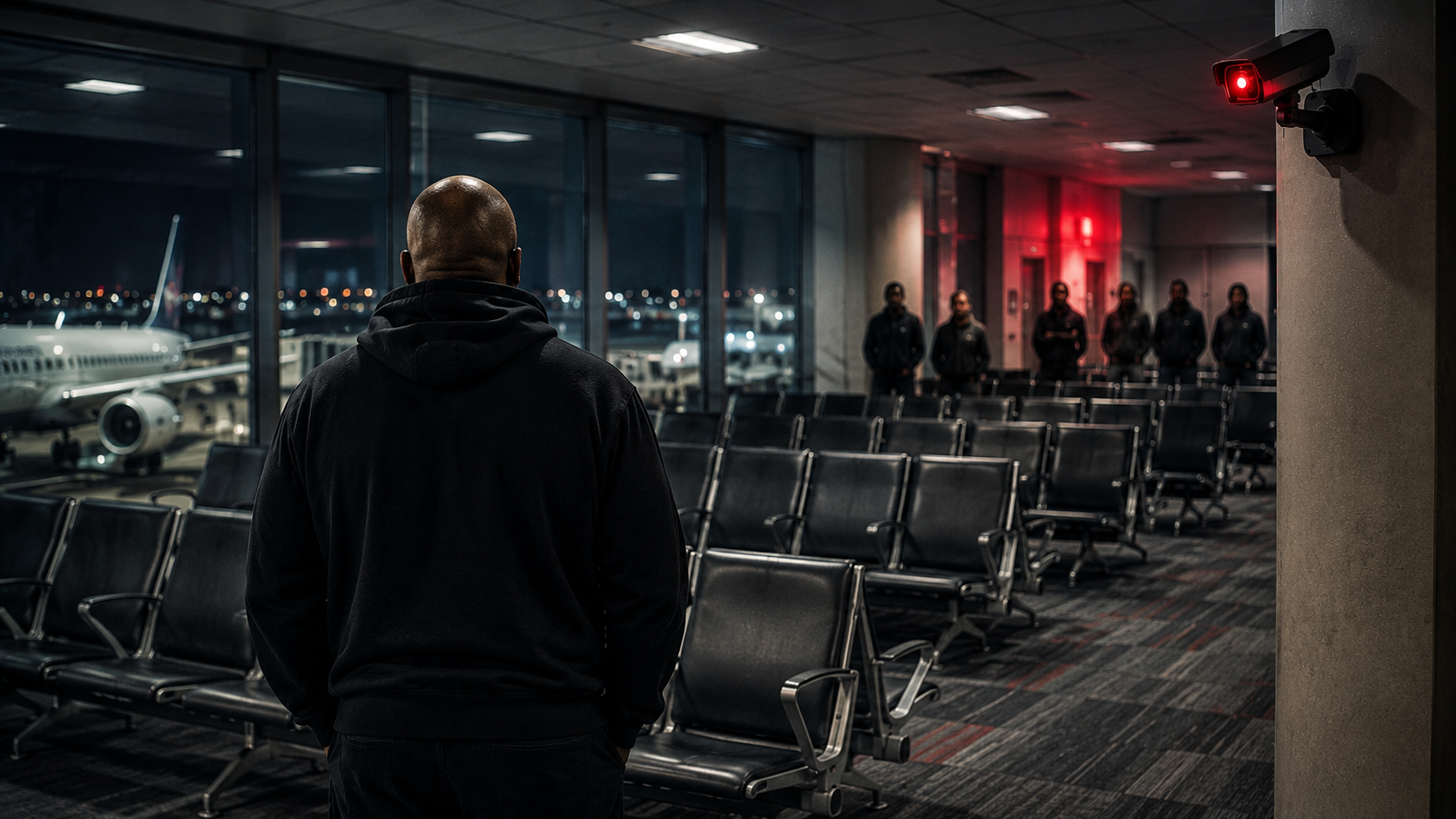
Horse Ankles told me his first real red flag didn't come from a single dramatic event — it came from repetition. Every time he was seated at a gate or on a commercial flight, strangers nearby would have conversations "within earshot" that referenced private details about his life: recent trips, recent conversations, people he'd been talking to. The first time or two, he waved it off as coincidence. By the third or fourth time, in the same environment, with different people saying strikingly similar things, he knew something else was going on.
That kind of pattern recognition — recognizing that isolated "coincidences" are actually a repeating structure — is one of the first things I tell people to pay attention to when they reach out to me about a possible gang stalking situation. If you're noticing that pattern in your own life and want a structured way to start tracking it, our GANG STALKING: A Target's Field Manual walks through exactly how to separate genuine patterns from noise.
The Honeypot Origin Story
What made this interview different from most is that Horse Ankles says he eventually traced his entry into the program back to a specific point of origin: a woman he met in college. He describes it as a "honeypot" — a relationship that, in hindsight, served as the emotional anchor for years of surveillance and harassment that followed. One of his key pieces of evidence was her public social media activity, which he says referenced private details he'd never shared with her directly, details that had only come up in conversations with the people surveilling him.
Whether or not every targeted individual can trace their situation back to a single point of origin, documenting the digital footprint around a suspected trigger event is critical — and it's exactly the kind of evidence that's easiest to lose if you don't know how to preserve it correctly. That's why we put together How to Document When You Can't Trust Your Own Devices, which covers how to capture and preserve this kind of evidence when you suspect your own phone or computer may be compromised.
Workplace Harassment and the "Carrot and Stick"
Horse Ankles says nearly every job he's held in the past 15 to 16 years has involved some form of workplace harassment tied to his situation — but not in a constant, escalating way. He described it as a "carrot and stick" dynamic: early encounters felt almost like unsolicited mentorship, subtly steering him toward certain career paths, including military service and eventually a CIA application. Over time, he says, the tone shifted and became more hostile.
This kind of behavioral shaping is one of the harder patterns to document because it doesn't look like harassment at first — it looks like influence. Our Targeted Individual Survival Guide Video Series breaks down how to recognize behavioral modification tactics over time, not just the more obvious intimidation tactics.
The FBI Field Office and the "Wink and Nod"
Perhaps the most striking part of this conversation was Horse Ankles' account of formally reporting what was happening to him. After a training exercise near Fort Bragg where he says five or six people orchestrated a coordinated harassment episode on his flight, he reported it up his Army chain of command, who redirected him to the FBI. He says he laid out his entire history for two FBI agents in a secure interview room — and as he was leaving, one of them asked him, with what he described as "a smile in her eye," whether he'd ever replied to an intelligence agency before.
He never got a substantive follow-up after that. It's the kind of ambiguous, unresolved encounter that a lot of targeted individuals describe — official acknowledgment without official explanation. As someone who spent over 10 years in law enforcement before becoming a licensed private investigator, I can tell you that vague, non-specific reports rarely go anywhere with law enforcement agencies, which is exactly why documentation before you report matters so much.
A Theory Rooted in MK Ultra
Horse Ankles frames his experience through the lens of MK Ultra, the well-documented CIA program exposed by the Church Committee in the 1970s after roughly two decades of unwitting human experimentation. His theory: after MK Ultra's exposure, the tactics didn't disappear — they evolved from a controlled physical environment into what he calls a "prison without walls," where a coordinated network of people, rather than a single facility, maintains the surveillance and psychological pressure wherever the target goes.
It's a striking framework, and one that a growing number of targeted individuals reference when trying to explain the coordinated nature of what they're describing. History doesn't repeat itself exactly, but Horse Ankles isn't the only person I've spoken with who sees the parallel.
Where He's At Today
Despite everything he's described, Horse Ankles says what keeps him going is community — connecting with other targeted individuals, sharing documentation, and pushing back against the isolation that these tactics are designed to create. He specifically credited the growing public conversation around gang stalking as a source of hope, and he's not alone in feeling that recognition matters more than vindication right now.
If you're going through something similar and want to talk it through with someone who has both investigative and law enforcement experience, you can Book a Consultation directly with me.
Full Interview Transcript
Lance: Hey folks, today we've got Horse Ankles, who is a targeted individual who's going to share his stories. How you doing today, sir?
Horse Ankles: I'm doing great. How about yourself?
Lance: I'm doing awesome. As a private investigator, I get a lot of people calling me and reaching out about different situations. At first, I just thought it was mental health. Then it kept happening, and I started to research it more to see if some of it's true and some may not be. It's got me leaning toward the majority of it not being mental health — it's actual things that are going on. So what I wanted to do is interview people like yourself so they can give their side of the story and tell me what's happening with them, to help them out.
Horse Ankles: That sounds great, man. Lance, I want to thank you for your time and for spreading awareness about this issue. Educating the public is one of the most important steps we can take as a community to rectify this. When I first started looking into it, it struck me how many people are reporting the same thing — there's no way this could be mass psychosis. I think it's important to dispel that first, so I thank you for helping with that.
Lance: Great. I want to mention Horse Ankles' YouTube channel link will be posted in the video description — subscribe and follow him. I also have resources on my website for gang stalking: techniques, strategies, video series, and consultations if someone wants to talk to somebody. Let's get into the questions. What was the first moment you remember thinking something isn't right here, before you had any framework like gang stalking or targeted individual? What triggered it, and what did you do?
Horse Ankles: In this early stage, I was still trying to figure things out and second-guessing myself a lot. I think the best way to summarize it is pattern recognition — repeated themes in encounters. A lot of it started in commercial airports and flights. Whenever I was seated at my gate, and later on the plane, I'd encounter strangers I didn't know. They were different every time, except for one exception. If there were two or more of them, they'd have a conversation within earshot referencing things pertinent to me — places I'd recently been, activities I'd recently done, even things I'd said to certain friends. The first time or two I waved it off as coincidence. But once it kept happening in the same environment repeatedly, every time I was at a gate or on a flight, by the third or fourth time I knew something was up. If it was just one person, they'd pretend to be on a phone call doing the same thing. Each time, what they said got increasingly pertinent — private details a stranger would have no way of knowing. That's when I knew this was highly coordinated and organized, though at that point I still didn't know who was behind it.
Lance: What type of job did you have during this time? Were you a popular person, a celebrity, someone who worked in government? What was going on that would cause this?
Horse Ankles: Lance, I'm just a normal dude — a completely average guy. Knowing what I know now, I'm aware of how I became a targeted individual and who initiated it. But at the time, just normal jobs: I was a college student, worked retail, worked for two different airlines at Logan Airport in Boston. I later enlisted in the Army and served just over four years, and I experienced it there too. It followed me everywhere regardless of what I was doing, which was very strange.
Lance: You said you knew what started this. Tell me about that — what was the trigger? Did you do something to the person?
Horse Ankles: I need to be especially careful with this one, but as I've shared on my own channel — my entry into the targeted individual program was initiated by a woman I met in college, a mutual friend. Embarrassingly, it took me a long time to figure this out, but I fell into a honeypot trap. I know she was the point of origin because she was directly involved. One of the giveaways was that on her public social media, she'd post pictures with captions referencing things I'd never told her — things that were only being spoken about by the gang stalkers, with no way she could've known otherwise. That was the point of origin for me. Later on, about a year before a training exercise I've talked about, I saw the same gang stalker more than once — the only time that happened. He would reference her specifically and encourage me to reach out and make amends. She served as the emotional anchor for almost the entirety of my time as a targeted individual.
Lance: Since then, what are some of the tactics they've used against you, besides the airport encounters and the social media posts?
Horse Ankles: There's a laundry list. It was actually through your video about the gang stalking manual that I found — I was excited something like that had been found and talked about online, but it also gave me uneasy feelings, because as I read through it line by line, I kept telling myself, this has happened to me. That's a strong indicator this is an organized program, not random, and not some paranoid delusion. Just to name a few: nearly every place of work I've had in the past 15 to 16 years has involved workplace harassment. At first it would be an occasional customer who was the gang stalker, saying something very pertinent — and I think part of why I was put into this program was for behavioral modification. It wasn't constant insults or intimidation. It's a game of carrot and stick. In those early days, they acted almost like a mentor, role model, or parent, steering me toward gaining government experience and later applying to the CIA, which I did. I won't give them full credit for that — those were things I wanted to do anyway — but they were nudging me along that path. Over time, it became more stick than carrot.
I've recently started looking at gang stalking through the lens of MK Ultra, the well-documented CIA program exposed by the Church Committee in the 1970s after about 20 years. In those days, the human experiments happened in controlled environments. After MK Ultra was exposed, I don't think the CIA ever really stopped programs like that — I think the targeted individual program is a continuation, applying lessons learned from how MK Ultra was found out. One way they're enabling it now is by creating a prison without walls — you no longer have a static, controlled physical environment. The gang stalkers themselves serve as that traveling controlled environment. Their tactics mirror the East German Stasi and COINTELPRO. When a targeted individual is constantly surrounded, constantly under overt surveillance, that has real psychological effects — and that's how the gang stalkers function as the traveling, curated version of the prison without walls.
Lance: Have you ever tried to report it, and who did you report it to? What did they say, and what did they do?
Horse Ankles: In the beginning, I was second-guessing myself, telling myself it was just weird coincidence. Then I started seeing repeated patterns and behavior, even though it wasn't the same individuals each time — almost like they were following a script. Before I reported it to anyone, I went as long as I could without reporting, to gather my own information and make sure what I was experiencing was real, not a paranoid delusion. I was also trying to figure out who would want to do this to me and why, since I'm just a totally normal guy — like pretty much every targeted individual out there. The first time I reported it was during a training exercise, when I'd traveled to the Fort Bragg area in North Carolina with my NCOIC. I experienced a gang stalking episode on that flight that was too big to ignore — five or six of them, seated in front of me, relentless harassment and intimidation for the entire flight. When I landed, I talked to my supervisor about it. Since I was an intelligence analyst in the Army, we followed our training and reported it to Army Counter Intelligence. A warrant officer at my unit redirected me to military police and counter intelligence personnel out of Fort Bragg — now Fort Liberty — who recommended I talk to the FBI. So the next day I went to their field office. I was brought into a secure room and interviewed by two female FBI agents. I laid everything out — not just that incident, but the prior gang stalking incidents too — and explained why I'd been hesitant to report it earlier, because it was just so strange. Because it happened on an official Army training trip, with a large, overt group involved, they took a lot of notes. On my way out, one of the agents looked at me with a smile in her eye and asked, "Have you ever replied to an intelligence agency before?" I said yes. She just smirked and that was that. It's my opinion the FBI is aware of this program — I don't think they're directly involved, I think it's strictly a CIA program — but as their sister agency, defending national security and state secrets at home, I think they're aware and, at best, assist in keeping it a secret. That was the first time I reported it, to the FBI. I was told someone would be in touch, and there was one follow-up about a week later, just confirming I'd made a report — no real information. When I returned to my duty station and called that FBI office, the first time they looked it up and confirmed the report existed, but it got increasingly dismissive, and then I had no further contact.
Lance: Because I was a police officer for over 10 years, I know that if somebody came to me with what you're describing back then, I'd have had a different mentality — "okay, that's nice, have a good day" — because in law enforcement you deal with specific crimes. If somebody comes with just a feeling, they don't care. They want specific incidents they can investigate. Did they break into your house? Did they steal your car? Was your car tampered with — fluids taken out, tires scratched or deflated — or do you just have a feeling something happened?
Horse Ankles: Absolutely. When I was in the Army working as an intel analyst, we used the term "actionable intelligence." Sure, this is information being reported, and I'm documenting it — but can we do anything about it? I completely agree with that standard.
Lance: Let's talk about what's going on now. What are you doing today to deal with it? Are you just accepting it and living your life as best you can?
Horse Ankles: As a targeted individual, it's very important to have mental and intestinal fortitude every single day, especially if you're dealing with heavy gang stalking and the technological component too. If you don't take care of yourself and don't have the right mentality, it can really bring you down. I have good days and bad days, but what gives me hope is that awareness of gang stalking and the term "targeted individual" is increasing. Looking at MK Ultra as historical precedent gives me even more hope — that program was exposed after 20 years. It's my opinion the targeted individual program, as we know it today, really took off after September 11, 2001 — the Patriot Act, the Department of Homeland Security, state-run fusion centers. If we use the early 2000s as a starting point, we're right around that 20-year mark now. I think in our lifetime this will be exposed, and hopefully targeted individuals will be vindicated, because we aren't crazy — there isn't mass psychosis in the United States. This is a government-run program that's happened before and is happening again with different technology and tactics. It's important to take care of yourself and remind yourself you're not alone. I really found out I was a targeted individual after looking online and realizing this is happening to thousands of people, not just me. Finding a sense of community is important. I'm a service-oriented person — I believe in service to your community and your country — and I feel like if I don't do my part in talking about this, I'm doing everyone a disservice, because staying silent lets it go on longer. I get a sense of purpose in trying to educate others by sharing my story and letting people know they're not alone. There are a lot of people out there helping targeted individuals, and you're one of them — so I want to thank you directly for that.
Lance: Not a problem at all. Everybody, this is Horse Ankles — his link is in the video description, make sure you follow him. And if you're not subscribed, subscribe to my channel, and we'll see you on the next one.