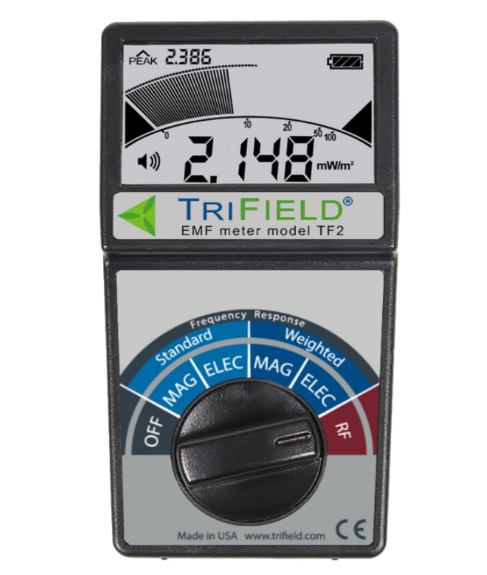
For many people in the targeted individual community, electromagnetic fields are one of the most talked-about — and least understood — pieces of the puzzle. Is that headache from the Wi-Fi router, a nearby cell tower, or something more deliberate? Without a real measurement, it's just a guess. That's where an EMF meter comes in.
In the video above, I walk through the TriField TF2 EMF Meter — a handheld device that measures five separate readings: magnetic field, electric field, frequency-weighted magnetic, frequency-weighted electric, and RF (radio and microwave frequencies, including most 5G signals). Having all five in one unit matters, because different sources produce different types of fields, and a meter that only reads one type will miss the rest.
Why Documentation Starts With the Right Equipment
As a licensed private investigator with 25 years of experience and over 10 years as a police officer before that, I've seen how much a credible paper trail matters when a case ever needs to be taken seriously by an attorney, a landlord, or law enforcement. A single EMF reading proves very little on its own. But consistent readings, logged over time, with dates and locations attached, start to build something that looks like evidence rather than anecdote.
That's the real value of a tool like the TriField TF2. It's made in the USA, gives fast digital readings instead of slow, over-averaged numbers, and includes a peak-hold function so you can catch brief spikes from digital sources like Wi-Fi routers, smart meters, and cell towers.
What the Meter Can — and Can't — Tell You
It's important to go into this with realistic expectations. Elevated RF or magnetic field readings near a power line, a refrigerator, or a cell tower are common and usually explainable. Before assuming a reading points to something targeted, rule out the obvious sources first: appliances plugged in with reversed polarity, older wiring, nearby smart meters, or simply being close to infrastructure like power lines and cell towers. A meter like this is a documentation tool, not a verdict — it tells you what's present, not who put it there or why.
Used consistently, though, it's one of the most practical tools available for building your own record. Combined with a documented evidence log, timestamps, and photos, EMF readings become part of a broader, more credible picture.
Related Detection Equipment
An EMF meter is a strong starting point, but it's just one piece of a full detection setup. Many in the TI community also use RF signal detectors for a narrower, more targeted RF sweep, hidden camera and bug detectors to check hotel rooms or vehicles, and GPS tracker detectors to sweep a vehicle for unauthorized tracking devices. I'll be covering each of these in more detail in upcoming videos and articles, so check back for the full equipment series.
If you decide the TriField TF2 is right for your situation, it comes with a 9V battery, a quick-start card, a full instruction manual, and a soft-shell carry case — and it's backed by a 1-year manufacturer warranty with free, unlimited support from AlphaLab if you run into questions using it.
As an Amazon Associate, I earn from qualifying purchases made through the links in this article.
If you're a targeted individual, documentation is your most important tool.
An EMF meter can help you build an objective record of unusual electromagnetic activity — but readings alone aren't enough. Pair your equipment with a proper evidence log and a clear understanding of your rights. The resources below were built by a licensed PI specifically for people in your situation.