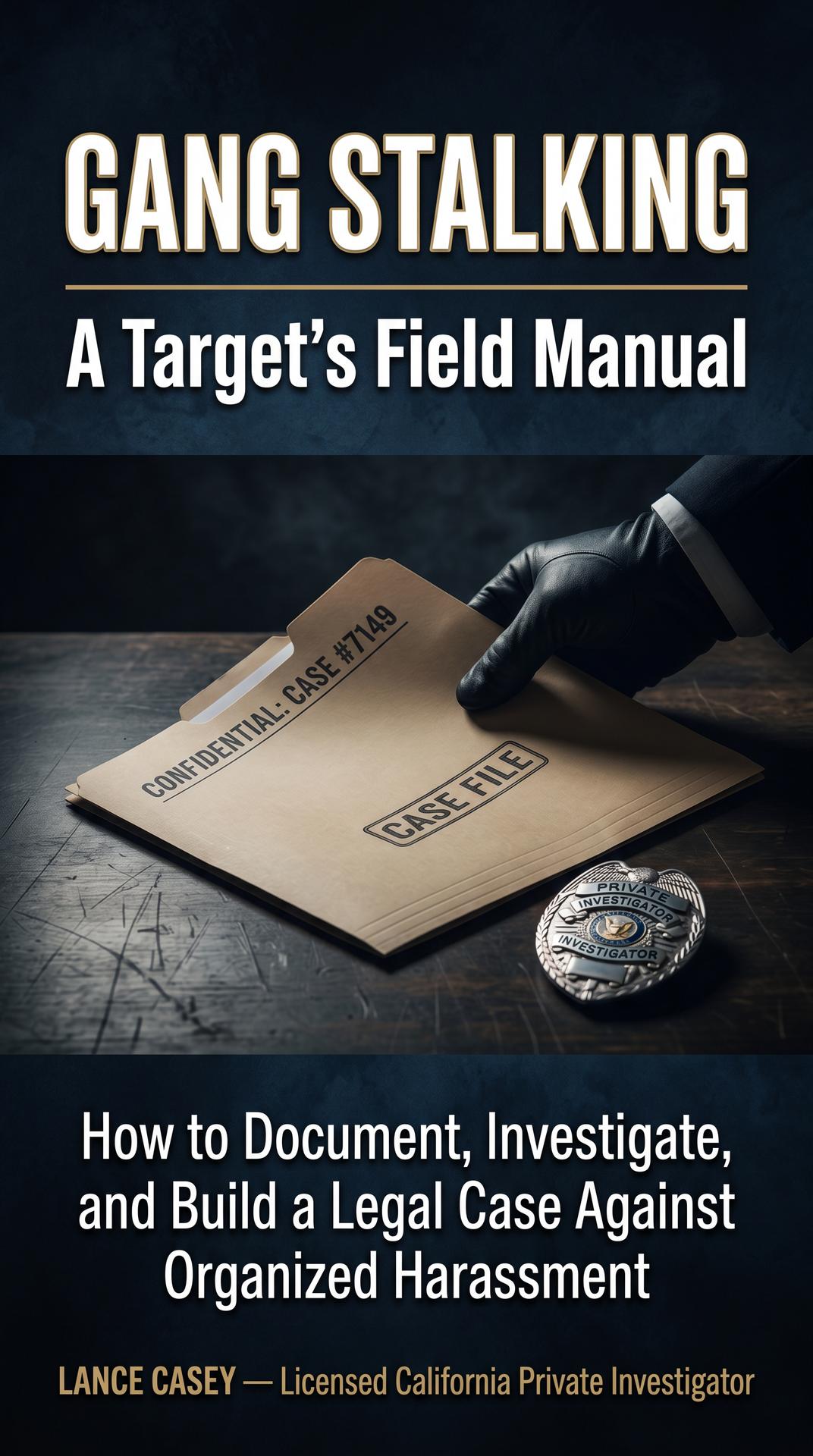
Gang Stalking:
A Target’s
Field Manual
How to Document, Investigate, and Build a Legal Case Against Organized Harassment
Written by a Licensed California Private Investigator with 25 years of field experience. The complete professional documentation system — built for civilians who are ready to stop surviving the harassment and start building the case.
All 50 states covered
What’s Inside the
Gang Stalking Manual.
Seven chapters and two professional appendices. Every section builds toward one objective: a case file that law enforcement can act on, an attorney can file on, and a court can evaluate.
What Gang Stalking Actually Is
The professional PI definition versus common misconceptions. How coordinated harassment is legally defined and why the distinction between belief and documentation is the foundation of everything that follows.
The 15 Real Signs of Organized Harassment
The specific, observable signs that distinguish real coordinated harassment from coincidence — with field notes from 25 years of professional surveillance work. Vehicle surveillance, foot surveillance, electronic indicators, and environmental harassment.
How Harassment Networks Actually Operate
How networks are built, how they communicate, how they collect intelligence on their targets — and where they fail. The inside view of organized harassment operations, based on documented programs and professional field experience.
The PI Documentation Protocol
The complete 30-Day Evidence Baseline system. Vehicle surveillance logging. Digital evidence preservation to chain-of-custody standards. The Surveillance Detection Route. The complete case file structure — built exactly the way a licensed PI builds it for court.
The Legal Framework
What each statute actually requires you to prove — California CCP § 527.6, Civil Code § 1708.7, Penal Code § 646.9, Penal Code § 422, and federal statute 18 U.S.C. § 2261A. Applicable in all 50 states.
Staying Operational — The Psychological Survival Framework
How to maintain documentation discipline under conditions specifically designed to prevent you from doing so. Hypervigilance management, sleep as a tactical resource, credibility protection, and the disclosure framework.
Bringing in a Professional — How to Hire a PI
When and how to bring in a licensed investigator. License verification protocol. Red flags to avoid. What a PI consultation actually produces. How professional corroboration changes the character of your case file.
Six Professional Templates
Gang Stalking Incident Log, Vehicle Surveillance Log, 30-Day Baseline Calendar, California Legal Reference Sheet, PI Hiring Checklist, and Digital Evidence Preservation Checklist — all ready to use from day one.
Three Systems.
One Case File
That Holds Up.
Gang Stalking Documentation Systems
The 30-Day Evidence Baseline. The Vehicle Surveillance Log with cross-reference tally. The Digital Evidence Preservation Protocol with three-layer chain-of-custody standard. The Surveillance Detection Route. Every system built to produce evidence that meets Federal Rule of Evidence 901 admissibility standards.
Gang Stalking Legal Frameworks
Every major federal and state legal remedy available to a gang stalking target — what each statute requires you to prove, what your documentation needs to show, and how the evidence you’re building maps directly to the legal elements that determine your outcomes. Applicable in all 50 states. External reference: 18 U.S.C. § 2261A.
PI Investigation Methods
The same methodologies a licensed private investigator uses to identify harassment network structure, conduct counter-surveillance, preserve evidence to legal standards, and build a case file that an attorney can take to court. No speculation. No forum theory. Professional method only.
This Manual Is Built
For You If…
- You are experiencing coordinated harassment and need a professional framework to document it
- You have gone to law enforcement and been dismissed — and you want to understand what documentation they actually require before you go back
- You want to understand your legal options under federal and state law before hiring an attorney
- You are logging incidents informally and need to organize them into a format a court can evaluate
- You want to know when and how to bring in a licensed PI — what to look for, what to avoid, and what a professional engagement actually produces
Documentation Is the Difference Between a Case and a Story.
Courts don’t act on feelings. Law enforcement needs evidence. Attorneys need a file. This manual gives you the professional tools to build one — for $19.99.
Instant PDF download. No account required.
Frequently Asked
Questions.
What Format Is the Manual?
The manual is a PDF — instant download after purchase. It is fully printable. All six appendix templates are designed to be printed and used as working field documents. No special software required to open it.
Does This Apply Outside California?
Yes. The documentation protocol works in all 50 states. The legal framework covers federal statute 18 U.S.C. § 2261A — which applies nationwide — in addition to California-specific statutes used as illustrative examples. The evidence standards referenced are federal admissibility standards applicable everywhere.
What’s the Difference Between the Manual
and a Consultation?
The manual is self-directed — the complete professional framework you can apply on your own. A consultation is one-on-one case assessment with Lance Casey reviewing your specific documentation and giving you a written next-step plan. Most people start with the manual and book a consultation once their 30-day case file is built.
Do I Need Documentation Before
I Buy the Manual?
No. The manual teaches you how to build documentation from scratch — starting with the 30-Day Evidence Baseline in Chapter 4. If you have existing documentation, the manual shows you how to organize and structure it to meet legal admissibility standards. Start where you are.
Everything You Need
To Build a Real Case.
$19.99. Instant download. No account required. The same professional methodology a licensed investigator uses to build a case file that holds up in court — now available for civilians who are ready to stop experiencing the harassment and start documenting it.
- 7 chapters of professional PI documentation methodology
- Complete legal framework — federal and all 50 states
- 30-Day Evidence Baseline system
- Vehicle and foot surveillance logging protocol
- Digital evidence preservation to legal admissibility standards
- 6 professional templates ready to use from day one
Instant PDF download
CA PI License #27617 — Verify at search.dca.ca.gov